Orchestration
How independent pieces get coordinated into work that finishes: control flow, hand-offs, retries and knowing what belongs in a script rather than a model.
Page 1/1

Agent Queues Need Backpressure
How AI work queues should control intake, priority, concurrency, retries, and human review so autonomous systems do not turn demand into uncontrolled motion.- Published on

Build the Smallest Autonomous Loop That Can Work
A practical way to scope AI autonomy around one observable goal, one bounded action surface, and one trustworthy feedback loop before expanding further.- Published on

Durable Execution for Long-Running Agents
How checkpoints, leases, event history, reconciliation, and resumable steps let agent workflows survive the failures that real work inevitably encounters.- Published on

The Agent Harness Is the Real Product
Why model capability only becomes dependable work through a harness that manages context, tools, state, permissions, recovery, and verification.- Published on

The Loop and Goal Workflow: How Long-Running AI Work Actually Finishes
A practical look at Codex Goal mode, automatic continuation, verification, steering, and the discipline required to make long-running agent work finish honestly.- Published on
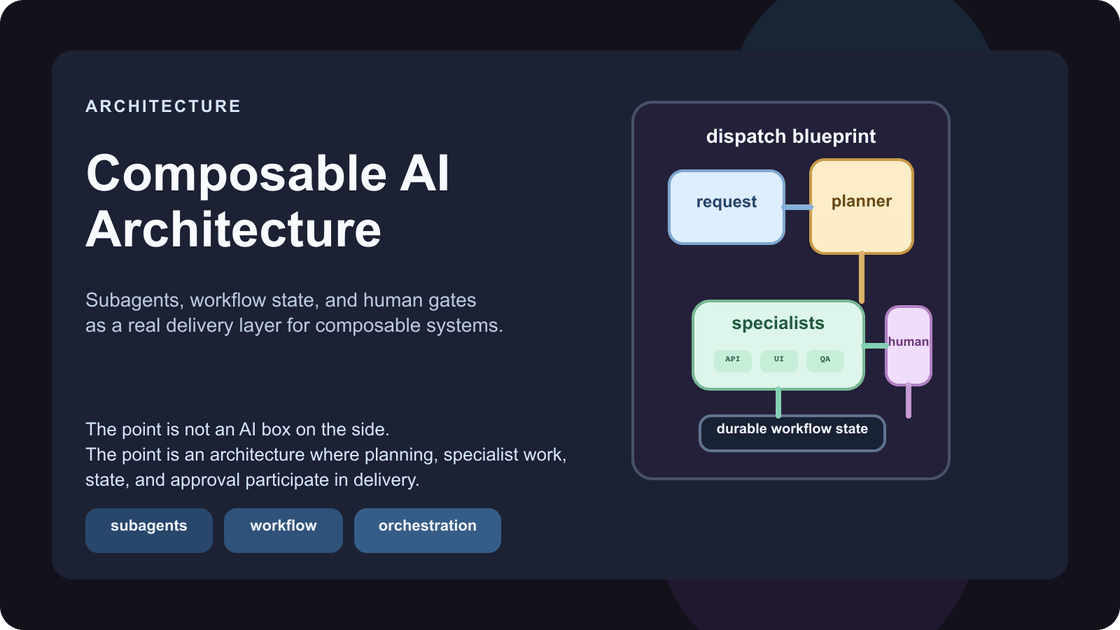
Composable AI Architecture
How subagents, workflow orchestration, and durable state turn AI from a bolt-on assistant into a composable delivery capability.- Published on

Orchestration Patterns for Real Agent Work
A practical guide to planner-executor-reviewer loops, handoffs, verification gates, and the operating patterns that make multi-agent work reliable.- Published on

RLMs, Context Rot, and Recursive Orchestrators
What Recursive Language Models are, why long-context systems degrade, and how recursive decomposition changes the design of agent orchestration.- Published on

What Gas Town Is Really Building
A close reading of Steve Yegge's Gas Town as a multi-agent operating model, with an emphasis on persistence, handoffs, merge discipline, and where the idea is genuinely useful.- Published on
Page 1 of 1